
Blog
10 After-the-Fact Tenant Improvement Mistakes in Florida
Looking for after-the-fact tenant improvement help in Florida? Avoid these 10 common mistakes and learn how to legalize commercial work.
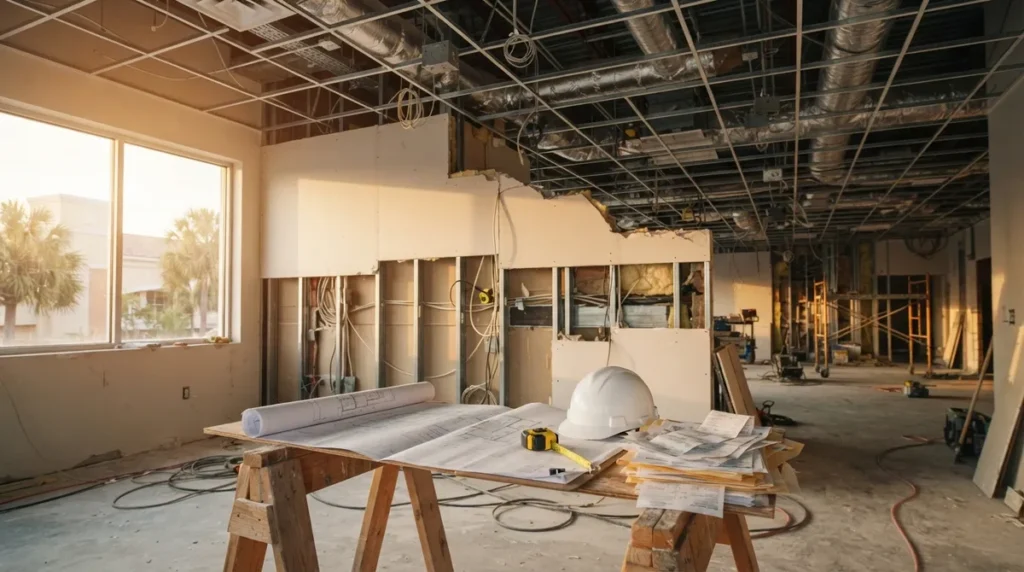
Key Takeaways
-
Unpermitted tenant improvements often surface during sales, refinances, insurance claims, or tenant turnover, so acting early gives you more control over timeline and cost.
-
Florida has no statewide permit application; your city or county building department controls the rules, forms, and fees, so confirm jurisdiction and pull permit history first.
-
Stop new work while the issue is open, since continuing construction can add violations and bury more unpermitted work behind finished surfaces.
-
Prepare accurate as-built drawings reflecting what actually exists, since reviewers reject guessed or idealized plans and may require sealed documents from Florida-licensed professionals.
-
Budget for possible selective demolition, testing, or exposure of concealed work, and document with photos, receipts, and product data to support approval.
-
A landlord's consent letter is not a government permit, and a permit does not satisfy lease obligations, so manage both tracks separately.
Picture this: your tenant finished a gorgeous build-out last spring. New walls, fresh lighting, a shiny break room. Then a code officer walks in, asks for the permit, and everyone goes quiet. If that sounds painfully familiar, take a breath. You are far from alone, and there is a path forward.
Folks who are looking for after the fact tenant improvement help in Florida usually land here for one of three reasons. Work was done without permits, work drifted away from the approved plans, or a lender, buyer, or inspector just discovered the gap. The good news is that many of these situations can be resolved. The less-good news is that a handful of common mistakes can turn a fixable problem into a costly one.
In this friendly guide, we walk through the 10 mistakes we see most often, what the process generally looks like, and how to protect your project, your lease, and your wallet in 2026. Whether you are a general contractor, a property manager, a realtor, or a business owner, you will find practical steps you can use right away.

What After-the-Fact Tenant Improvement Help Really Means
An after-the-fact (ATF) tenant improvement is commercial interior work that was started or completed without required permits, or work that differs from what was approved. Getting help means bringing that work into compliance with the local building authority.
Here is a key point many people miss: Florida does not have one statewide application for ordinary local building permits. Your city or county building department is the authority, and its rules, forms, and fee schedules control your path. The Florida Building Code, 8th Edition (2023), became effective December 31, 2023, but local amendments and administrative requirements still vary, so always confirm what applies to your address.
Tenant improvements often touch several regulated areas at once:
- Building and structural components, including partitions and ceilings
- Electrical, plumbing, and mechanical systems
- Fire protection and life safety, such as sprinklers, alarms, and egress
- Accessibility, especially restrooms, entrances, and counters
Cosmetic changes are not automatically exempt if they affect regulated systems or life safety. When in doubt, ask the building department before you assume.

The 10 Mistakes That Make After-the-Fact Permitting Harder
1. Waiting for the Problem to Go Away
It is tempting to hope nobody notices. But unpermitted work tends to surface at the worst moments: a sale, a refinance, an insurance claim, a change of tenant, or a routine inspection. The longer it sits, the more it can complicate a transaction or lease.
Acting early gives you control over the timeline. A calm, organized legalization process is almost always cheaper and less stressful than a rushed one under a deadline. If you want to understand the general landscape, our guide on how to legalize unpermitted work in Florida is a good place to start.
2. Continuing Work Before the Building Department Says Okay
This one is a big deal. If you keep building while the issue is unresolved, you may add new violations on top of old ones, bury more work behind finished surfaces, and increase the cost of corrections. Confirm the department's instructions before another nail is driven.
If a stop work order is already in place, treat it seriously and follow its terms. Our team has seen many owners get back on track by pausing, documenting, and responding the right way. When timing is tight, an urgent permit rescue approach can help you regain footing quickly.
3. Calling the Wrong Building Department
City lines are slippery. A property with a city mailing address may actually sit in unincorporated county jurisdiction, or the other way around. Filing with the wrong authority wastes weeks.
Before you do anything else, confirm who has jurisdiction over the parcel and pull the permit history. You can use the building department lookup tool and the open permit search to get oriented. For deeper background, read which Florida jurisdiction reviews my project.
4. Skipping the Records Research
Before drawing anything, you need to know what was permitted, what was closed, and what is still open. Old permits may be expired, never finalized, or tied to a prior tenant. Sometimes the "unpermitted" work is actually covered by a permit that simply never got a final inspection.
Good records research can change your whole strategy. It can reveal that you need a different path, such as reviving an expired permit rather than filing a brand-new ATF application. If that sounds like your situation, see how to close an expired permit in Florida.
5. Handing Over Drawings That Do Not Match Reality
This is the heart of most ATF packages. Reviewers want to see what actually exists in the space, not an idealized version. Existing-condition plans, often called as-built drawings, document walls, doors, fixtures, equipment, and system locations as they stand today.
Depending on the jurisdiction and scope, the authority may require signed and sealed documents from Florida-licensed design professionals. Sloppy or guessed drawings invite rejection and rounds of comments. Learn more about our as-built drawings and commercial plans services.
6. Assuming Concealed Work Will Just Be Accepted
Work hidden behind walls and above ceilings is tough to approve on faith. The building official may ask for selective demolition, exposure of concealed work, testing, or other evidence. Exact requirements depend on the jurisdiction and the project.
Plan for this possibility in your budget and schedule. Photographs, receipts, product data, and installer information can help support your case. A licensed professional can often reduce how much exposure is needed by documenting what can be verified. Our engineer letters and engineering support are built for exactly this kind of situation.
7. Forgetting That Different Trades Mean Different Reviews
A single tenant improvement can trigger building, electrical, plumbing, mechanical, fire, and sometimes accessibility review. Treating it as one simple permit is a recipe for surprise comment letters.
Here is a quick snapshot of how scope often maps to review:
| Work Performed | Typical Review Areas | Common Documentation |
|---|---|---|
| New or moved partitions | Building, fire, accessibility | Floor plans, egress layout, wall types |
| New lighting and outlets | Electrical | Panel schedules, load calculations |
| Added sinks or restrooms | Plumbing, accessibility | Fixture counts, riser or layout details |
| New HVAC or ductwork | Mechanical | Equipment data, duct layout |
| Sprinkler or alarm changes | Fire protection | Fire plans, device layouts |
| Change in use or occupant load | Building, fire, zoning | Occupancy analysis, egress calculations |
Our MEP engineering and structural engineering teams work under one roof, which keeps these pieces coordinated instead of scattered.
8. Ignoring Occupancy, Egress, and Accessibility
Commercial build-outs can quietly change a space's character. Adding seating, storage, or a kitchen area may affect occupant load, exit requirements, fire protection, and accessibility. These changes can trigger extra review beyond basic building code checks.
If the tenant changed how the space is used, you may also need to look at a certificate of use or certificate of occupancy. We break down the difference in certificate of occupancy vs. certificate of use.
9. Confusing Landlord Approval With Government Approval
This mix-up happens constantly. A landlord's signed consent letter is a lease matter. It is not a permit, and it does not satisfy the building department. The reverse is also true: a permit does not replace your obligations under the lease.
Both tracks matter. Property managers and brokers often need to coordinate with owners, tenants, and lenders at the same time. If that is your role, our pages for property managers and commercial brokers explain how we help keep everyone aligned.
10. Expecting a Guaranteed Approval and a Fixed Price
Here is the honest truth. After-the-fact permitting does not guarantee approval, and it does not waive code compliance. The authority may require corrections, added plans, further inspections, and applicable fees or penalties. Costs vary widely by jurisdiction and scope.
Go in with realistic expectations and a flexible contingency. For a closer look at what drives pricing, see after-the-fact permit Florida cost and the penalty for building without a permit in Florida.
A Typical Path to Legalizing Tenant Improvements
Every jurisdiction is a little different, but most successful ATF projects follow a similar rhythm. Think of it as a roadmap rather than a rulebook.
- Identify the jurisdiction and permit history. Confirm which city or county controls the property and what permits exist.
- Ask the department what it requires. Request its after-the-fact or legalization instructions in writing when possible.
- Document existing conditions. Field-measure the space and prepare accurate as-built plans.
- Engage licensed professionals. Bring in a Florida-licensed architect or engineer when sealed drawings are required.
- Prepare the permit package. Assemble applications, contractor information, calculations, and product approvals as required.
- Submit and track the review. Respond to comments quickly and completely.
- Complete inspections and corrections. Open concealed work if asked and fix deficiencies.
- Close out. Finish final inspections and obtain any needed certificates.
Want a plain-English overview of the general process? Take a look at how to get an after-the-fact permit in Florida and our after-the-fact and expired permits service page.
Who Needs What: A Quick Reference
Different readers face different pressure points. Here is a handy way to see where you might fit.
| Who You Are | Common Trigger | Best First Move |
|---|---|---|
| General contractor | Inherited a space with unknown past work | Pull permit history, document existing conditions |
| Property manager | Tenant turnover reveals unpermitted build-out | Notify owner, confirm jurisdiction, start records review |
| Realtor or broker | Buyer's inspection flags unpermitted work | Research open permits, plan a legalization timeline |
| Design or trade professional | Client needs sealed plans fast | Outsource drafting and engineering support |
| Business owner or tenant | Notice from code enforcement | Stop new work, respond, and get professional guidance |
If a sale is on the clock, our realtor closing support can help. And if you are dealing with open items found at the closing table, read open permit found at closing.
Practical Tips to Keep Your Project Moving
A few small habits can save you weeks. These are the ones that pay off again and again:
- Keep a clean paper trail. Save invoices, photos, inspection reports, and correspondence with the department.
- Gather product information early. Sprinkler heads, fixtures, and equipment cut sheets can speed review.
- Respond to comments in full. Partial answers often trigger another round of review.
- Ask about code edition and local amendments. Do not assume your last project's rules still apply.
- Budget for corrections. A little cushion keeps surprises from becoming emergencies.
Comments and rejections are a normal part of the process. If you hit one, our article on why a building permit gets rejected may ease some of the worry, and our revisions and resubmittals team handles the back-and-forth for you.
Why Local Knowledge Matters Across Florida
A Tampa office, a Miami retail suite, and an Orlando restaurant space may all need similar scopes, but each building department can ask for something different. Submittal formats, review timelines, and fee structures vary from place to place.
That is why experience across many jurisdictions is so valuable. We work across all 67 Florida counties, including busy markets like Miami-Dade County, Broward County, Hillsborough County, and Orange County. Knowing which door to knock on, and what the reviewer will want to see, takes much of the guesswork out of the process.
Every county page on our site shows how local requirements can differ, so feel free to browse our full Florida coverage area.
When It Makes Sense to Bring In Help
You can certainly start the process on your own, and some small projects are straightforward. But professional support tends to pay for itself when:
- The scope touches multiple trades or life-safety systems
- Sealed drawings or an engineer letter are required
- A closing, lease deadline, or lender is waiting
- You received a notice of violation or stop work order
- You are managing several properties or counties at once
At 1 Contractor Solutions, we act as an outsourced permitting department. We handle permit filing and tracking, plan review coordination, drafting, and in-house sealed engineering, so you are not chasing outside consultants for every comment. We also offer code compliance violation support when enforcement is already involved. You can follow us on LinkedIn or follow us on Facebook for permitting tips and updates, and you can read 1 Contractor Solutions reviews on Google to see how other clients describe working with us.
For a broader look at expert-level guidance, our related article on whether unpermitted commercial TI can be legalized in Florida goes even deeper.
Final Thoughts: Progress Beats Perfection
Finding out that a tenant improvement was never permitted can feel like a punch to the gut. But remember, this is a very common situation, and building departments handle after-the-fact applications regularly. The owners who come out ahead are the ones who act early, document carefully, avoid the mistakes above, and lean on people who know the local landscape.
You do not have to figure this out alone. If you are ready for friendly, experienced guidance, reach out and get a free quote today. Share the address and a quick description of what happened, and we will help you map out the next step toward a compliant, closed-out project.
FAQs
Can I get an after-the-fact permit if the tenant improvement is already finished?
In many cases, yes. Most Florida building departments have a process for legalizing completed work, though the exact steps depend on your city or county. Expect to document existing conditions, and be ready for inspections or corrections.
Will the building department make me open walls or ceilings?
Sometimes they do. When work is concealed, the building official may require selective demolition, testing, or other evidence before approving it. Good documentation and professional verification can sometimes limit how much needs to be exposed.
Do I need a Florida-licensed architect or engineer for an ATF commercial permit?
It depends on the scope and the local authority's rules. Many commercial packages call for signed and sealed plans from Florida-licensed design professionals, especially when structural, life-safety, or multiple trades are involved. Ask the building department early so you are not surprised.
What extra fees or penalties apply to unpermitted commercial work?
That varies by jurisdiction. Many departments charge applicable permit fees, and some add penalties or investigation fees for work done without a permit. Confirm the current fee schedule with your local authority so you can budget accurately.
Does landlord approval replace a government permit?
Nope, they are two separate things. Landlord approval is a lease matter, while permits are a legal requirement from your city or county. You will generally need both to keep everyone happy and your project compliant.
We do this work every day across all 67 Florida counties. Call (866) 314-6931 and we will tell you what your situation actually requires — including when you do not need us.
Related services
Permit Facilitation & Filing
You have a crew scheduled, a client asking for dates, and a permit sitting somewhere in a queue you cannot see. We file it, w…
See the servicePlan Review Coordination
A permit in plan review is not one queue. On a commercial project it can be six queues, each with its own reviewer, its own c…
See the serviceReady to get your permit moving?
One call tells you which jurisdiction controls your project, what it will take, and what it will cost. Most of the time we can scope it on the phone.