
Blog
8 Steps to Legalize After the Fact Pools in Florida (2026)
Learn 8 friendly, practical steps to legalize after the fact pools in Florida, from jurisdiction checks to inspections, safety, and final closeout.
Key Takeaways
-
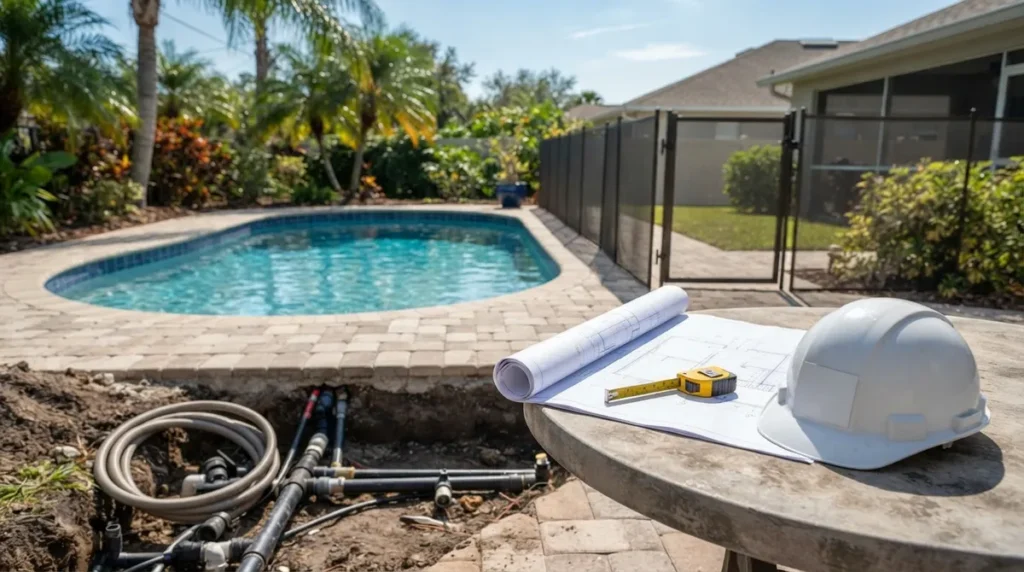
Florida has no statewide after-the-fact pool permit process or fee schedule; each city or county sets its own forms, fees, penalties, and review steps, so start by confirming your exact jurisdiction.
-
Being already built does not guarantee approval: the existing pool must still meet current code, safety, and zoning requirements, and any shortfalls must be corrected.
-
Expect that buried plumbing or electrical work may need to be exposed for inspection (Miami-Dade, for example), so plan for possible excavation or alternative verification methods.
-
Ask your building department for a written list of required documents and a current fee estimate before buying drawings; requirements may include a site plan, construction details, electrical and plumbing info, and sealed or as-built drawings.
-
Verify pool safety items such as barrier height, self-closing and self-latching gates, door alarms, and GFCI/bonding protection, since these are commonly checked during after-the-fact inspections.
-
Finalizing the permit protects property value and prevents closing delays, which matters when selling; residential building permits are separate from Chapter 514 Department of Health public-pool operating permits.
So you've got a gorgeous pool in the backyard, and then someone mentions the dreaded word: permit. Maybe a previous owner built it without one. Maybe a contractor swore they'd handle the paperwork and never did. Or maybe a buyer's inspector just flagged it before closing. Take a breath. You're far from alone, and there's a path forward.
Dealing with after the fact pools in Florida simply means applying to your local building department to legalize a pool that was already built without the required approval. The good news? It's a common situation, and it's often fixable. The not-so-fun news? Florida has no single statewide after-the-fact application or fee schedule. Every city and county sets its own rules, forms, penalties, and review process.
In this friendly 2026 guide, we'll walk you through eight practical steps, from figuring out who controls your property to passing the final safety inspection. Whether you're a homeowner, a real estate professional, or a contractor cleaning up someone else's mess, you'll find clear, honest direction here. Let's turn that permit headache into a finished file.
Step 1: Confirm Which Jurisdiction Controls Your Pool
Before you do anything else, figure out who actually has authority over your address. This sounds simple, but it trips up plenty of people. Properties near city lines can fall under a city building department or the county, and the rules differ.
Your first move is to contact the building department for your property's jurisdiction and ask what permits are needed to legalize the existing pool. You can use a building department lookup tool to confirm the right office. Ask for current written requirements and a fee estimate before you spend a dime on drawings.
Here's why this matters so much: a pool project often involves more than one approval. Depending on the jurisdiction, you may need:
- A building permit for the pool itself
- Electrical permits for bonding, lighting, and equipment
- Plumbing permits for pool piping and gas lines
- Zoning review for setbacks and lot coverage
- Engineering sign-off in certain cases
Miami-Dade County, for example, identifies subsidiary electrical and plumbing permits and requires a zoning improvement permit for above-ground pools. Your local rules may look similar or quite different, so always verify for your exact address.
Step 2: Understand What "After the Fact" Really Means
An after-the-fact permit, sometimes called a retroactive permit, is a request to approve work that already exists. The building department reviews the pool as if you had applied before building it, then decides what must be documented, corrected, or inspected.
Here's the part many owners misunderstand: being already built does not guarantee approval. The pool still has to meet code, safety, and zoning requirements. If something falls short, you may need to correct it, and local fees or enforcement consequences can apply.
| Common Assumption | The Reality |
|---|---|
| "It's already built, so they have to approve it." | It must still meet code, safety, and zoning requirements. |
| "There's one statewide process." | Each city or county sets its own forms, fees, and review steps. |
| "A normal pool permit costs the same." | Local penalties or extra fees may apply to after-the-fact work. |
| "Public pool rules apply to my backyard pool." | Chapter 514 operating permits are for public pools, not typical residential ones. |
If you want a deeper look at how this process works statewide, our guide on how to get an after-the-fact permit in Florida covers the fundamentals, and you can also read up on penalties for building without a permit in Florida so nothing surprises you.
Step 3: Gather Your Documentation
Think of this as packing your suitcase before the trip. Having a complete, organized submittal makes plan review smoother and cuts down on frustrating rejection rounds.
Exact requirements are set by your local authority, including whether sealed plans or extra documentation are needed. That said, expect to provide items like these:
- A site plan showing the pool, the house, property lines, setbacks, fences, and other features
- Pool construction details such as dimensions, depth, shell type, and equipment location
- Electrical information covering bonding, grounding, GFCI protection, and lighting
- Plumbing information for circulation, drains, and any gas heater lines
- Safety barrier details showing fencing, gates, alarms, or other approved safety features
- Any survey or as-built drawings your jurisdiction requests
If you don't have drawings of what exists, that's where as-built drawings come in. A drafter measures and documents the pool as it stands so reviewers can evaluate it. You can also explore our site plan services if your property needs a clean, accurate layout.
Step 4: Prepare for Engineering and Sealed Plans
Some jurisdictions are satisfied with a basic as-built package. Others want engineering, particularly when structural, electrical, or MEP concerns can't be verified by eye. Whether sealed drawings are needed is a local call, so ask your building department early.
When engineering is required, the engineer evaluates what was built and certifies that it meets applicable standards, or identifies what must be corrected. With in-house sealed drawings, the drafting and the engineer's review happen under one roof, which means fewer handoffs and faster fixes when a reviewer has comments. Learn more about engineering support and how an engineer letter can help resolve specific questions.
Not sure whether your pool needs sealed plans? Our article on whether a sealed drawing is required for after-the-fact permits breaks it down in plain English.
Step 5: Plan for Inspections and Concealed Work
Here's where after-the-fact pools get a little tricky. In a normal permit, inspectors see the work at each stage: excavation, steel, plumbing, electrical bonding, and so on. With an after-the-fact pool, much of that work is already buried under concrete, decking, or soil.
The permitting authority may require inspections of the completed work. Miami-Dade, for instance, states that plumbing or electrical work covered before inspection approval may need to be exposed so it can be inspected. Any portions that don't comply must be corrected before they can be concealed again.
In practice, this might mean:
- Exposing bonding connections at the pool shell or equipment pad
- Opening access to buried plumbing or electrical conduit
- Verifying wire sizes, depths, and protection
- Providing photos or documentation when exposure isn't feasible, if your jurisdiction allows alternatives
Don't panic if this sounds disruptive. Many jurisdictions work with owners on reasonable verification methods, and an experienced permitting team can negotiate what's practical. Our overview of what happens during a Florida ATF site inspection shows what to expect on the day.
Step 6: Make Sure Pool Safety Requirements Are Met
Safety is non-negotiable, and for good reason. Florida's pool safety framework addresses barriers and other approved safety features designed to prevent accidental drownings. Local inspection checklists spell out the details.
For example, the City of Orlando's residential pool checklist calls for building and electrical pool-safety inspections before the pool is filled. Since an after-the-fact pool is usually already full, your jurisdiction will tell you how it handles that situation.
Items inspectors commonly look at include:
- Barrier or fence height and gate latching
- Door and window alarms where the house forms part of the barrier
- Self-closing, self-latching gates
- Electrical bonding and GFCI protection
- Safe placement of equipment and overhead lines
Because code editions and local amendments vary, confirm the applicable requirements with the authority having jurisdiction. If something fails, fix it and request a re-inspection. A tidy, well-documented correction usually goes over better than a rushed one.
Step 7: Submit, Track, and Respond to Review Comments
Once your package is ready, it's time to file. This is where patience and persistence pay off. Reviewers often issue comments, and each one needs a clear, documented answer.
A smooth submittal process generally looks like this:
- File the application and pay the required fees
- Track the status so nothing sits idle
- Respond to every reviewer comment with revised drawings or explanations
- Resubmit promptly to keep momentum
- Schedule and pass required inspections
- Receive final approval and close out the permit
Delays usually happen when comments are only partially answered or when drawings don't match what's on site. Working with a team that handles permit facilitation and filing plus revisions and resubmittals can keep your file moving. For a complete walkthrough of the paperwork side, see our after-the-fact permit application guide.
Step 8: Close It Out and Protect Your Property
Finishing the permit isn't just a box to check. A closed, finaled permit protects your property value, simplifies future sales, and keeps lenders and insurers comfortable. An open or unpermitted pool can surface during an appraisal or inspection and hold up a transaction.
This is especially important for real estate professionals and investors. A pool without final approval can delay a closing, so addressing it early is smart. If you're dealing with a sale, our guide on whether a permit hold can delay a Florida real estate closing is worth a read, and our realtor closing support is built for exactly these timelines.
Also, remember that homeowners often discover these issues when they're already stressed. If you've received a notice, our resource on code compliance violations explains how to respond calmly and correctly.
Residential Pools vs. Public Pools: Don't Mix Them Up
One more important distinction. A residential building permit is a different animal from a public-pool operating permit. Florida Statutes Chapter 514 requires a Department of Health operating permit for public swimming pools, such as those at community associations, hotels, and apartment complexes.
| Feature | Residential Pool Permit | Public Pool Operating Permit |
|---|---|---|
| Issued by | Local city or county building department | Florida Department of Health (Chapter 514) |
| Purpose | Approves construction and safety of the pool | Authorizes operation of a public pool |
| Renewal | Closed out after final inspection | Renewed annually |
| Fees | Set locally | Set by statute (for example, $75 to $125 annually for pools up to 25,000 gallons) |
According to the 2025 Florida Statutes, the public-pool application also requires a copy of the local final inspection, and a new owner of an existing permitted public pool must apply within 30 days of an ownership or name change. These are public-pool fees, not residential after-the-fact building-permit costs, so don't use them to estimate your own budget.
Why Work With a Florida Permitting Team
Legalizing a pool can feel like juggling zoning, electrical, plumbing, safety, and engineering all at once. That's exactly what a dedicated permitting partner does every day. 1 Contractor Solutions acts as Florida's outsourced permitting department, handling plan preparation, filing, tracking, reviewer comments, and closeout across all 67 counties. With in-house drafting and sealed engineering, comments get resolved quickly instead of bouncing between outside consultants.
If you're a contractor, our pages for pool and spa contractors and general contractors show how we support your pipeline. Homeowners can start with our homeowner resources, and you can see our full range of after-the-fact and expired permit services. Want to see what other people say? Visit us on Google — 1 Contractor Solutions to read reviews, and feel free to follow us on LinkedIn or follow us on Facebook for more Florida permitting tips.
Ready to Legalize Your Pool?
Dealing with after the fact pools in Florida doesn't have to be overwhelming. Start with your jurisdiction, gather solid documentation, plan for inspections and safety checks, and keep communication open with the reviewer. Every pool is different, and every building department has its own personality, so a little local knowledge goes a long way.
You don't have to figure it out alone. If you'd like a clear plan, a realistic timeline, and a team that handles the heavy lifting, get a free quote today and let's get your pool legal, safe, and stress-free.
FAQs
Can I legalize a pool built without a permit in Florida?
In many cases, yes! You apply to your local city or county building department for an after-the-fact permit, and they'll tell you what documents, inspections, and corrections are needed. Approval isn't automatic just because the pool exists, but a well-prepared submittal gives you a strong shot.
How much does an after-the-fact pool permit cost in Florida?
There's no single statewide fee, since each jurisdiction sets its own fees and any penalties. Ask your building department for a current written fee estimate before you start, and budget for drawings and possible engineering too.
Will I have to expose buried pool work for inspection?
Possibly. Some jurisdictions, like Miami-Dade, state that concealed plumbing or electrical work may need to be exposed for inspection, and noncompliant portions must be corrected before being covered again. Your building department will explain what verification methods they accept.
Do I need a Department of Health permit for my backyard pool?
Typically not. The Florida Department of Health operating permit under Chapter 514 applies to public swimming pools, such as those at community associations or hotels. A private residential pool is generally handled through your local building department instead.
What documents do I need for an after-the-fact pool permit?
Expect to provide a site plan, pool construction details, and electrical, plumbing, and safety barrier information, though exact requirements vary by jurisdiction. Some places also want sealed plans or as-built drawings, so confirm the checklist with your local office first.
We do this work every day across all 67 Florida counties. Call (866) 314-6931 and we will tell you what your situation actually requires — including when you do not need us.
Related services
Permit Facilitation & Filing
You have a crew scheduled, a client asking for dates, and a permit sitting somewhere in a queue you cannot see. We file it, w…
See the servicePlan Review Coordination
A permit in plan review is not one queue. On a commercial project it can be six queues, each with its own reviewer, its own c…
See the serviceReady to get your permit moving?
One call tells you which jurisdiction controls your project, what it will take, and what it will cost. Most of the time we can scope it on the phone.